AI Head-to-Head
Compare A Brief History of Time vs Concepts of Physics
Which book deserves a spot on your reading list next? Explore our side-by-side comparison of summaries, lessons, and buying options.

Academic
A Brief History of Time
by Stephen Hawking
☆☆☆☆☆
0.0
Buy Options
| Pages | 212 |
| Difficulty Level | Advanced |
| Est. Reading Time | 5.3 hrs |
| Publish Year | 1988 |
Academic
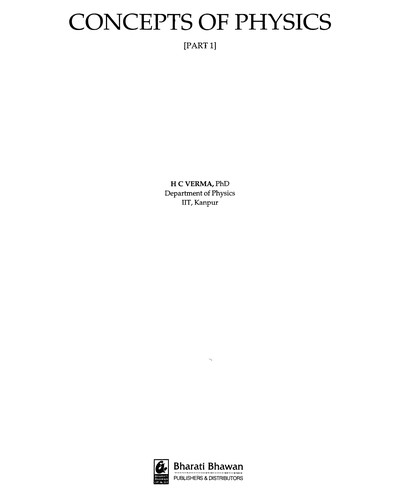
Concepts of Physics
by H.C. Verma
☆☆☆☆☆
0.0
Buy Options
| Pages | 462 |
| Difficulty Level | Advanced |
| Est. Reading Time | 11.6 hrs |
| Publish Year | 1992 |
🎯
Who Should Read Which?
Book 1, "A Brief History of Time," targets a general adult audience with an interest in fundamental questions about the universe, cosmology, and theoretical physics, requiring no prior expert knowledge. Book 2, "Concepts of Physics," is specifically designed for high school students and those preparing for competitive physics examinations, serving as a comprehensive textbook for foundational mechanical physics.
💡
Core Takeaway Comparison
Book 1 offers a conceptual understanding of complex topics like the Big Bang, black holes, space-time, and the unification of physics, aiming to broaden one's worldview on the cosmos. Book 2 provides a rigorous and practical mastery of classical mechanics, enabling students to understand principles and solve a wide array of quantitative problems.
✍️
Writing Style & Complexity
Book 1 adopts an explanatory and narrative style, simplifying highly complex scientific theories with minimal mathematics, making it accessible but still intellectually demanding due to the subject matter. Book 2 employs a traditional textbook style, featuring detailed derivations, illustrative examples, and a vast collection of exercises, emphasizing problem-solving and quantitative application.
👑
The Final Verdict
To gain a broad, conceptual understanding of theoretical physics and cosmology without deep mathematical rigor, start with "A Brief History of Time." To build a strong, quantitative foundation in classical mechanics essential for academic study and competitive exams, prioritize "Concepts of Physics." They serve very different educational objectives.